
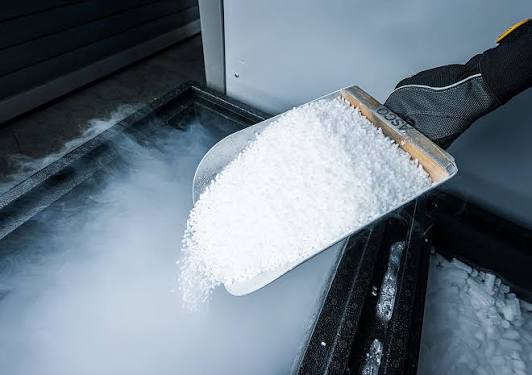
Dry ice keeps vaccines cold on long journeys, helps exporters move fresh fish and meat, cleans factory machines without water, and creates the fog effect you see at weddings and concerts. More Ugandan businesses are using it every year, yet many first-time buyers are unsure how it works or how to handle it safely.
This guide explains what dry ice is, its main uses in Uganda, how to choose the right pellet size, and the safety rules everyone who handles it should know.
What Is Dry Ice?
Dry ice is carbon dioxide (CO₂) in solid form. It is extremely cold, about −78.5°C, compared with 0°C for ordinary ice.
Unlike water ice, dry ice does not melt into a liquid. It changes straight from a solid into CO₂ gas, a process called sublimation. That means no water, no mess and no soggy packaging, which is why it is so useful for cooling and transport.
At Oxyplus Services Ltd, we manufacture carbon dioxide and supply dry ice for businesses across Uganda.
Common Uses of Dry Ice in Uganda
Cold Chain for Vaccines, Medicines and Lab Samples
Hospitals, laboratories and research projects use dry ice to keep vaccines, blood samples and biological specimens frozen during transport, especially to upcountry facilities far from reliable power.
Food Transport and Export
Fish, meat, ice cream and frozen foods stay frozen for longer in insulated boxes packed with dry ice. Because it leaves no water behind, the product and packaging stay dry. To learn more about other gases used in food, read how CO₂ and nitrogen keep food fresh or see our food grade gases.
Dry Ice Blast Cleaning
In dry ice blasting, small pellets are fired at high speed to remove grease, paint, ink and residue from machinery. The pellets turn to gas on impact, so there is no water damage and no extra waste to clean up. Factories, printers and food processors use it to clean equipment with less downtime.
Catering and Events
Event organisers use dry ice to create a low-lying fog for weddings, concerts and stage shows. Caterers use it to keep drinks and desserts cold at outdoor events.
Industrial and Engineering Uses
Engineers use dry ice for shrink fitting (cooling a metal part so it contracts and fits into another), emergency cooling during breakdowns, and keeping goods cold during power cuts.
Choosing the Right Dry Ice Pellet Size
Oxyplus supplies dry ice pellets in 3 mm, 9 mm, 10 mm and 12 mm sizes. As a general guide:
3 mm Pellets
Small pellets have more surface area, so they cool quickly and are commonly used for dry ice blast cleaning and fast chilling.
9 mm to 12 mm Pellets
Larger pellets sublimate more slowly, so they last longer. They are a good choice for transport, cold storage and shipping boxes that need to stay cold for many hours.
Not sure which size you need? Tell us what you are cooling and for how long, and our team will recommend the right size and quantity.
How to Handle Dry Ice Safely
Dry ice is safe when handled correctly. These rules prevent the most common accidents.
Never Touch It With Bare Hands
At −78.5°C, dry ice can cause frostbite-type burns in seconds. Always use insulated gloves or tongs, and wear eye protection when breaking or blasting it.
Always Use It in a Well-Ventilated Area
As dry ice sublimates, it releases CO₂ gas. CO₂ is heavier than air and can collect in low or enclosed spaces, pushing out oxygen. In a closed room, cold room, basement or vehicle cabin, this can cause headaches, dizziness and, in serious cases, suffocation.
Never Seal Dry Ice in an Airtight Container
The gas has to escape. A sealed bottle, tight-lidded jar or closed cooler box can build up pressure and burst violently. Use containers designed for dry ice that let gas vent safely.
Don’t Transport It in a Closed Car Cabin
Carry dry ice in the boot or an open, ventilated area, and keep windows open if it must travel inside the vehicle. Never leave it in a parked car.
Keep It Away From Children and Food Contact
Never eat or swallow dry ice, and never put pellets directly into drinks that will be served. Keep it out of reach of children and pets.
How to Store Dry Ice
Dry ice sublimates continuously, so plan to buy it close to when you need it. To make it last longer:
- Store it in insulated, vented containers such as our cryoseal containers.
- Keep the container closed except when adding or removing ice, but never airtight.
- Fill empty space in the box with crumpled paper to reduce air circulation.
- Keep it in a cool, well-ventilated place, away from direct sunlight.
- Do not store dry ice in a normal freezer or a sealed cold room. The extreme cold can damage the thermostat, and the gas can build up.
Transporting and Shipping With Dry Ice
When shipping goods with dry ice, use a sturdy insulated box that allows gas to escape, and label the package clearly as containing dry ice. Airlines and courier companies have their own rules for dry ice, including labelling and weight limits, so always confirm with your carrier before sending.
Why Buy Dry Ice From Oxyplus?
- We manufacture CO₂ ourselves, so we control quality from production to delivery. Learn why gas purity matters.
- Four pellet sizes to match cooling, transport and blasting needs.
- Storage solutions, including cryoseal containers, from one supplier.
- Certified operations: see our certifications, including ISO 9001 and UNBS.
- We also supply industrial gases, medical gases and firefighting equipment.
Visit us: Plot 192, Block 234, Jinja Road, Katuba (opposite Centenary Bank, Kireka Branch), Bweyogerere, Kampala. Call: 074 455 5510 / 020 099 5510 · Email: Info@oxyplus.co.ug
Ready to order? Contact us with the quantity and pellet size you need.
Frequently Asked Questions
Where can I buy dry ice in Kampala?
Oxyplus Services Ltd supplies dry ice pellets from our facility on Jinja Road, Katuba, Bweyogerere. Contact us to confirm availability and quantities before collection.
How long does dry ice last?
It depends on the amount, pellet size, container and temperature. In a good insulated container, larger pellets last longer than small ones. Buy it as close as possible to when you need it.
Is dry ice dangerous?
It is safe when handled correctly. The main risks are cold burns from touching it, CO₂ build-up in closed spaces, and pressure build-up in sealed containers.
Can I put dry ice in my home freezer?
No. It can damage the freezer’s thermostat, and the CO₂ gas needs to vent safely. Use an insulated, vented container instead.
What is the difference between dry ice and normal ice?
Dry ice is solid carbon dioxide at about −78.5°C and turns directly into gas. Normal ice is frozen water at 0°C and melts into liquid.